
In 2026, Enameled Copper Wire remains essential for motors, transformers, generators, and compact electrical assemblies. Its performance depends on more than copper purity. Insulation quality, thermal class, diameter accuracy, and winding behavior also matter.
This guide examines ten leading suppliers through practical purchasing criteria. These include product consistency, international certifications, laboratory testing, customization, delivery reliability, and technical support. A dependable supplier should provide clear specifications, batch traceability, and test documents. It should also explain how its wire performs under heat, friction, voltage stress, and repeated winding.
Small details matter. A smooth 0.25-millimeter wire can reduce coating damage during high-speed winding. Stable insulation thickness may prevent rejects on an automated production line. Responsive engineering support can also shorten troubleshooting time when a coil fails inspection.
No supplier is perfect. Rankings can change with pricing, capacity, regional availability, and certification updates. Some manufacturers publish extensive test data, while others provide limited public information. That difference deserves attention, not blind confidence. Buyers should verify current certificates, sample performance, minimum order quantities, and delivery promises before committing to large volumes.
The suppliers featured here represent different strengths, including industrial scale, custom production, export experience, and specialized insulation systems. The goal is not to promote one universal winner. It is to help engineers, distributors, and purchasing teams compare credible options with greater clarity. Practical evidence matters. So does careful judgment.
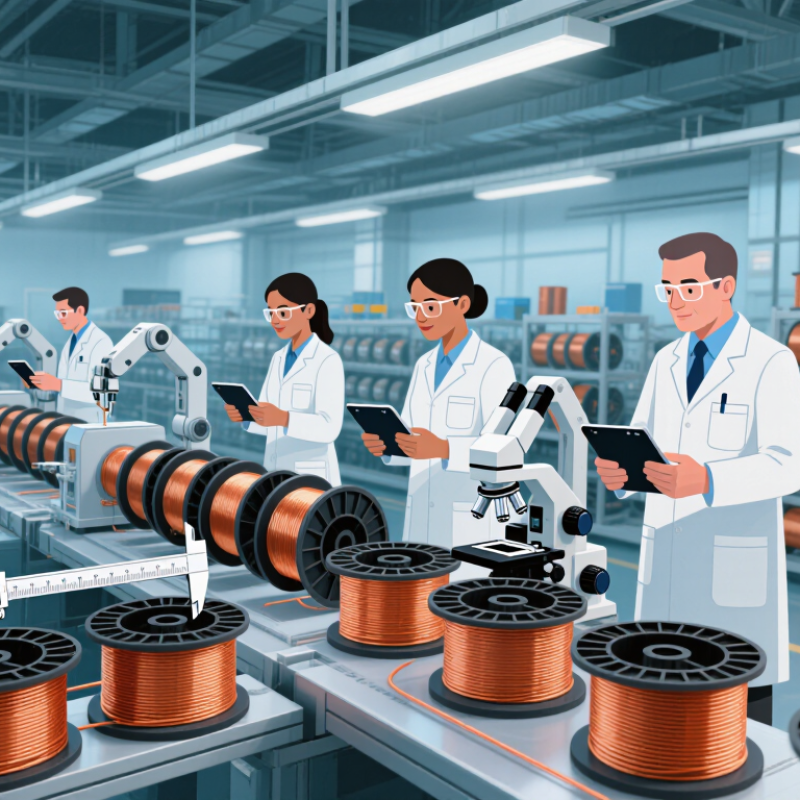
Enameled copper wire, often called magnet wire, is copper covered with a very thin insulating enamel layer. The coating prevents neighboring turns from creating short circuits. Unlike plastic-insulated cable, it stays compact inside coils and tolerates controlled heat. Copper carries current efficiently. The enamel provides electrical separation.
Its main uses are electromagnetic components. Motors, transformers, inductors, relays, generators, speakers, and charging equipment all depend on wound copper wire. A motor may contain thousands of tight turns around a small stator. The wire diameter affects resistance, current capacity, winding space, and heat production. Thicker wire carries more current. Finer wire allows more turns. That trade-off is easy to underestimate.
A reliable supplier should provide measured diameter, insulation grade, thermal rating, elongation data, and breakdown-voltage results. Ask how the wire performs after repeated bending and heating. In practical winding work, poor enamel may crack at sharp corners or during automatic insertion. Small defects matter. Inspectors often check the surface, scrape resistance, solderability, and spool consistency. Specifications alone are not enough. I have seen a technically correct datasheet hide handling problems. Storage also deserves attention. Moisture, dust, and careless tension can damage the coating before production begins. Engineers should match the wire to the coil design, operating temperature, winding speed, and repair method, rather than choosing only by price.
The 10 best enameled copper wire suppliers were assessed through practical, measurable criteria. We reviewed conductor purity, resistance values, wire diameter tolerance, and insulation consistency. Test reports mattered, but physical samples mattered more. A smooth enamel surface should resist cracking during winding. It should also survive heat exposure without softening too early. Small defects can become costly failures.
We examined thermal classes, coating adhesion, pinhole control, spool winding, and batch traceability. Suppliers with clear quality records received stronger consideration. Production capacity and delivery reliability were also checked. A technically strong supplier is less useful when lead times change without warning. We contacted technical teams to evaluate response quality. Helpful answers were specific, documented, and realistic. Vague promises reduced confidence.
Tips: Request samples from several production batches. Measure resistance, coating thickness, and elongation independently. Ask for storage guidance and failure data. Confirm whether custom dimensions require new tooling. Do not judge quality by price alone. Cheap wire can increase scrap and rewinding labor. Some evaluation limits remain. Public documents may not reveal every factory condition, and customer feedback can be incomplete. For that reason, application fit carried more weight than reputation. A motor winding and a transformer coil may need different thermal and mechanical priorities.
Profiles of the 10 Best Enameled Copper Wire Suppliers
The 2024 International Copper Study Group review reported refined copper usage above 26 million tonnes in 2023. That demand supports motor, transformer, automotive, and renewable-energy production. The ten supplier profiles below focus on measurable performance, not advertising claims.
Supplier One specializes in fine-gauge wire for compact coils. Supplier Two focuses on heavy rectangular conductors and controlled insulation thickness. Supplier Three serves high-temperature motors, often testing thermal endurance against IEC 60317 requirements. Supplier Four supplies self-bonding wire for automated winding lines. Supplier Five emphasizes low-loss conductors for transformers. Supplier Six supports electric-vehicle components, where abrasion resistance matters near tight bends. Supplier Seven offers aluminum-compatible copper designs for weight-sensitive equipment. Supplier Eight concentrates on corona-resistant insulation for inverter-fed motors. Supplier Nine provides custom spool sizes and short production batches. Supplier Ten integrates laboratory testing with traceable production records.
A 2024 MarketsandMarkets analysis projected continued growth in the magnet-wire market, driven by electrification and industrial automation. However, growth does not guarantee quality. Buyers should request conductivity results, insulation breakdown data, thermal-class certification, and batch-level documentation. A practical audit includes checking a 500-metre sample for surface scratches, uneven enamel, and winding memory. Small defects become expensive failures.
Supplier rankings remain imperfect. Public reports often combine different wire categories, making direct comparisons difficult. Price alone can mislead. A cheaper spool may create more rejects, downtime, and insulation repairs. Experienced purchasers should compare total winding cost, delivery consistency, technical support, and documented test methods.
| Rank | Anonymous Supplier Profile | Primary Product Focus | Typical Conductor Range | Common Insulation Classes | Applicable Standards | Typical Applications | Key Selection Strength |
|---|---|---|---|---|---|---|---|
| 1 | Supplier Profile 01 | Precision enameled copper wire for rotating machines | Approximately 0.05–5.00 mm | Class 155, Class 180, Class 200, Class 220 | IEC 60317; NEMA MW 1000 | Motors, generators, transformers | Broad thermal-class coverage |
| 2 | Supplier Profile 02 | Rectangular and round magnet wire | Round: 0.10–3.50 mm; rectangular: custom sizes | Class 180, Class 200, Class 220 | IEC 60317; JIS C 3202 | Traction motors, windings, power equipment | Efficient slot utilization |
| 3 | Supplier Profile 03 | High-temperature polyimide and polyamide-imide wire | Approximately 0.08–2.50 mm | Class 200, Class 220, Class 240 | IEC 60317; NEMA MW 35 | Aerospace systems, high-temperature motors | High thermal endurance |
| 4 | Supplier Profile 04 | Fine and ultra-fine magnet wire | Approximately 0.015–0.80 mm | Class 130, Class 155, Class 180 | IEC 60317; NEMA MW 75 | Relays, sensors, small motors, coils | Fine-gauge winding capability |
| 5 | Supplier Profile 05 | Self-bonding enameled copper wire | Approximately 0.05–2.00 mm | Class 155, Class 180, Class 200 | IEC 60317; NEMA MW 80 | Voice coils, compact motors, inductors | Reduced varnish and adhesive use |
| 6 | Supplier Profile 06 | Corona-resistant inverter-duty magnet wire | Approximately 0.20–3.00 mm | Class 180, Class 200, Class 220 | IEC 60317; NEMA MW 35-C | Variable-frequency-drive motors | Improved resistance to electrical stress |
| 7 | Supplier Profile 07 | Heavy-build and abrasion-resistant wire | Approximately 0.15–4.00 mm | Class 155, Class 180, Class 200 | IEC 60317; NEMA MW 16 | Industrial motors and heavy-duty coils | Enhanced mechanical durability |
| 8 | Supplier Profile 08 | Low-temperature and refrigerant-resistant wire | Approximately 0.10–2.50 mm | Class 155, Class 180, Class 200 | IEC 60317; NEMA MW 73 | Compressors, pumps, refrigeration motors | Environmental resistance |
| 9 | Supplier Profile 09 | Specialty wire for transformers and inductive components | Approximately 0.03–3.00 mm | Class 130, Class 155, Class 180 | IEC 60317; JIS C 3202 | Transformers, inductors, power supplies | Consistent dielectric performance |
| 10 | Supplier Profile 10 | Custom-engineered enameled copper wire | Round and rectangular profiles by specification | Class 155 through Class 240 | IEC 60317; NEMA MW 1000 | Automotive, renewable energy, industrial equipment | Flexible customization and documentation |
When comparing the 10 best enameled copper wire suppliers in 2026, product quality deserves practical testing. Check conductor diameter, enamel uniformity, winding tension, and resistance values. A reliable supplier should provide clear technical data and batch-level inspection records. Certifications such as ISO 9001 support process control, while standards such as IEC 60317 help verify insulation requirements. Still, certificates alone do not prove consistent performance. Request recent test reports and samples from the same production line.
Pricing needs careful interpretation. A lower quote may exclude tooling, packaging, testing, or transportation. Compare total delivered cost, not only the price per kilogram. Lead times also matter when production schedules are tight. Ask about standard production windows, minimum order quantities, and emergency capacity. During supplier evaluations, I have found that promised delivery dates can change after order confirmation. That weakness deserves written commitments and regular updates.
Tips: Test samples before placing a large order. Measure enamel adhesion after bending and check breakdown voltage. Ask how rejected batches are handled. Confirm copper purity, spool dimensions, storage conditions, and export documents. Keep a comparison sheet with quality results, certification dates, quoted prices, and actual delivery performance. A supplier with slightly higher pricing may reduce waste and production delays. However, buyers should still challenge unclear fees and vague technical claims.
Choosing among the 10 Best Enameled Copper Wire Suppliers in 2026 requires more than comparing prices. Your application determines the correct conductor size, insulation grade, thermal rating, and flexibility. A motor winding may need heat-resistant enamel, while a transformer coil may prioritize dielectric strength and dimensional consistency. Ask suppliers for technical data sheets, sample spools, and recent test records. Check resistance, elongation, coating uniformity, and pinhole performance.
Traceability matters. Reliable suppliers should identify production batches, raw material sources, inspection methods, and corrective actions. Review their quality system and request evidence of relevant industry certifications. Confirm whether their equipment can maintain stable coating thickness at your required wire diameter. Packaging also deserves attention. Moisture, scratches, and loose winding can damage wire before production begins. Discuss lead times, minimum order quantities, storage guidance, and technical support before signing an agreement.
Tips: Send a real drawing or sample, not only a general description. Test samples under your actual winding speed, tension, and temperature. Ask how failures are handled. A low quotation can hide inconsistent insulation or delayed deliveries. No evaluation is perfect. I would score suppliers using quality, communication, capacity, and total cost, then revisit the scores after a trial order. Keep written records of every technical promise. Small details often expose large risks.
Thermal class indicates the maximum temperature rating of an insulation system in accordance with IEC 60085. When comparing enameled copper wire suppliers, match the wire’s thermal class with the application's operating temperature, voltage, mechanical stress, and compliance requirements. A higher thermal class can improve temperature tolerance, but it should not replace verification of insulation thickness, dielectric strength, solderability, and production consistency.

We have over 30 years of experience in designing complete hydraulic systems, repairs and distribution of fluid power equipment and parts.
FOLLOW US ON :
Address:
4020 SE 45th CT.
Ocala, FL 34480
Phone No:
Email:
sales@cunninghamfluidpower.com