How to Choose Surge Protection for TVs in 2026?
Choosing surge protection for a television in 2026 requires more than buying the cheapest power strip. Modern TVs contain sensitive panels, processors, Wi-Fi modules, and HDMI circuitry. A sudden voltage spike can damage components that are difficult or impossible to replace. Tvs Surge Protection should therefore be treated as part of a complete home entertainment setup, not as an optional accessory.
A reliable protector should provide a clear joule rating, response-time information, overload protection, and enough outlets for connected devices. Check the clamping voltage, warranty terms, and certification marks recognized in your region. Look for protection covering power, coaxial, Ethernet, or HDMI connections when those cables enter the television. One overlooked cable can still create a damaging path.
Experience also shows that specifications can be confusing. A higher joule rating is useful, but it does not guarantee unlimited protection. Surge protectors wear out after major events, even when the exterior appears normal. Replace units showing heat damage, buzzing, cracked plastic, or repeated breaker trips. Avoid covering the device or placing it beside heat-producing equipment. Keep it accessible.
Not every home needs the same solution. Apartments, rural properties, and homes with frequent storms may require different protection strategies. A certified electrician can assess grounding, wiring condition, and whole-home surge protection. This step is often ignored. It should not be. The best choice balances technical performance, installation conditions, connected equipment, and realistic replacement costs. Recheck the decision as your TV system changes.
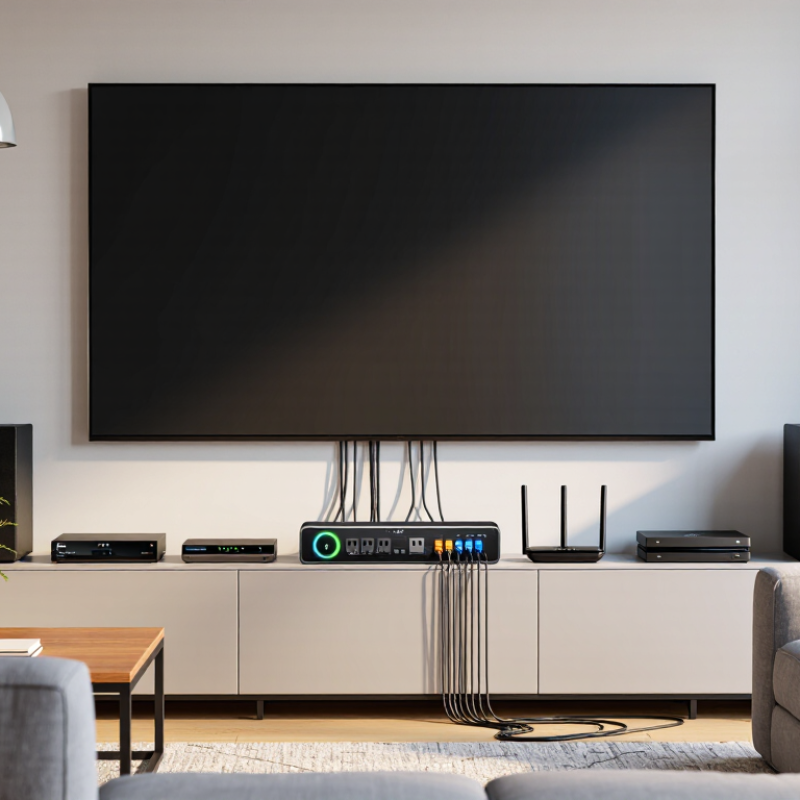
Identify TV Surge Risks Using IEEE C62.41.1 Location Categories
How to Choose Surge Protection for TVs in 2026?
IEEE C62.41.1 helps identify where a television sits within a building’s surge environment. Category C covers the service entrance and outdoor conductors. It faces the strongest lightning-related and utility switching exposure. Category B includes feeders and major branch circuits. Category A covers receptacles, long branch circuits, and areas deeper inside the building.
This location matters more than the television’s screen size. A TV beside a service panel may need stronger upstream protection than one in a bedroom. Category C commonly calls for service-entrance surge protection installed by a qualified electrician. Category B benefits from panel-level protection. Category A usually needs a listed point-of-use protector with sufficient joule and clamping specifications.
Use a short, direct connection.
In practical inspections, long grounding wires often reduce protection performance. Cable, antenna, and network connections can also carry damaging surges. Protecting only the power cord leaves these paths exposed. Bonding and grounding should follow local electrical requirements, not improvised shortcuts.
The categories are useful, but not perfect. A rural home, an apartment, and a commercial building can experience different surge patterns within the same category. IEEE guidance supports risk evaluation; it does not guarantee that a TV will survive every event. Check the installation location, connected cables, building wiring, and local conditions before choosing protection.
Match Protection Ratings to UL 1449 Third Edition Safety Requirements
How to Choose Surge Protection for TVs in 2026?
A television needs more than a high joule number. Match its protection ratings with documented safety testing. UL 1449 Third Edition introduced clearer requirements for let-through voltage, abnormal overvoltage, leakage current, and fire-related hazards. It also established Type 1, Type 2, and Type 3 surge protective device categories.
In 2026, Third Edition is a historical benchmark, not the newest edition. Confirm the current certification before purchasing. For a typical living-room TV, check the voltage protection rating, maximum continuous operating voltage, nominal discharge current, and short-circuit current rating. The device should identify its tested configuration clearly. “Surge protected” alone is weak evidence.
The numbers matter. NOAA’s National Severe Storms Laboratory estimates that lightning causes about one billion dollars in U.S. property damage each year. NFPA’s Home Structure Fires report found electrical distribution and lighting equipment appeared in 52% of reported home fires from 2016 through 2020. These figures do not prove every TV failure came from a surge. That distinction matters.
I have seen consumers compare joules first. That can mislead. A lower clamping voltage may offer more useful protection, but only when its test conditions are credible. Look for traceable certification, thermal protection, clear ratings, and installation guidance. One gap remains: household wiring and grounding can limit real-world performance, even with a compliant device. Check both. (Sources: UL 1449, Third Edition; NFPA Home Structure Fires; NOAA NSSL.)
Compare Joule Ratings, Clamping Voltage, and 330-400 V Limits
Choosing TV surge protection in 2026 means reading test values, not trusting a large joule number. The U.S. Energy Information Administration’s 2020 Residential Energy Consumption Survey found televisions in 96% of American homes. That broad exposure deserves careful protection. Joules describe absorbed energy under a specific test method. They do not directly predict the voltage reaching your television. IEEE C62.41.1 classifies surge environments, while UL 1449 evaluates protective devices.
For 120-volt systems, compare the clamping voltage, also called the Voltage Protection Rating, on the same basis. A 330-volt VPR generally allows less transient voltage through than a 400-volt VPR. That difference can matter to HDMI circuits and compact power supplies. UL 1449 uses defined surge waveforms, so a 2,000-joule claim without recognized certification is weak evidence. Do not compare joule ratings casually across different testing methods.
A practical choice includes UL 1449 certification, a VPR near 330-400 volts, thermal safety, and a grounding indicator. The 330-volt figure is not a universal legal limit. Mains voltage and safety standards vary by region. Check coaxial and Ethernet lines too. One unprotected cable can bypass the device. I would replace protection after a severe surge, even when its light remains active. That may be overly cautious. Indicator lights are not laboratory proof. IEEE C62.41.2 recommends matching protection to expected exposure, rather than buying the biggest printed number.
How to Choose Surge Protection for TVs in 2026? – Compare Joule Ratings, Clamping Voltage, and 330–400 V Limits
| Protection Category | Typical Joule Rating | Typical Clamping Voltage / VPR | Best Use for a TV | Evaluation |
| Basic outlet protection | 400–700 J | Usually above 500 V | Small or secondary TVs in areas with stable utility power | Entry level; limited energy capacity and weaker voltage control |
| General home-theater protection | 800–1,500 J | 400–500 V | Most modern TVs, streaming devices, soundbars, and game consoles | Balanced choice; suitable for ordinary household transients |
| Enhanced TV and AV protection | 1,500–2,500 J | 330–400 V | Premium OLED, QLED, Mini-LED, large-screen TVs, and connected AV systems | Preferred range; combines higher energy capacity with lower let-through voltage |
| High-exposure location protection | 2,500 J or more | 330–400 V when independently verified | Homes with overhead utility lines, frequent storms, or repeated power disturbances | Strongest plug-in option; should be combined with whole-home surge protection |
Key Specifications to Compare
| Specification | What It Measures | Recommended Selection for TVs | Important Limitation |
| Joule rating | The approximate surge energy the protective components can absorb over their service life | At least 800 J for basic use; 1,500–2,500 J for valuable home-theater equipment | Ratings are not always measured under identical conditions, so joules alone do not determine quality |
| Clamping voltage / VPR | The voltage level at which the surge protector begins diverting excess voltage during a standardized test | Prefer a verified 330–400 V value for a 120 V television circuit; lower let-through voltage generally offers better protection | The value depends on the test waveform and should be compared only between products tested to the same standard |
| Maximum continuous operating voltage | The highest normal AC voltage the protector is designed to withstand continuously without conducting heavily | For nominal 120 V systems, select a unit specifically rated for the local 120 V/60 Hz supply | This is not the same as clamping voltage; do not use one specification as a substitute for the other |
| Response time | How quickly the protective circuit reacts to a transient | Look for a published test method and safety certification rather than choosing solely by a nanosecond claim | A very fast response time does not guarantee a low clamping voltage or high energy capacity |
| Protection modes | Whether protection is provided between line-neutral, line-ground, and neutral-ground | Choose a product with clearly stated protection on all relevant modes | Protection cannot compensate for missing or improperly grounded household wiring |
| Status indicator and disconnect | Shows whether the surge components remain operational and disconnects them after failure | Select visible status monitoring and a thermal safety disconnect | An illuminated indicator does not prove that the device can stop every surge |
Practical 2026 rule: For a 120 V TV circuit, prioritize a safety-certified surge protector with a documented 330–400 V clamping-voltage range, at least 1,500 J for valuable equipment, full protection-mode coverage, and a functioning-status indicator. Install whole-home surge protection separately when the property has frequent storms, overhead power lines, or a history of damaging surges.
Note: Joule ratings and clamping-voltage values are test-dependent specifications. Verify the applicable safety standard, operating voltage, grounding requirements, and local electrical rules before installation. No plug-in protector can guarantee protection against a direct lightning strike.
Choose Response Times Below 1 Nanosecond for Sensitive TV Circuits
How to Choose Surge Protection for TVs in 2026?
For sensitive TV circuits, choose surge protectors with response times below 1 nanosecond. This target reduces the interval before clamping begins. However, response time alone can mislead buyers. The IEEE C62.41.2 standard commonly tests surges using a 1.2/50 microsecond voltage waveform and an 8/20 microsecond current waveform. These events can damage power supplies, HDMI ports, and network circuits within a connected television.
Check the measured limiting voltage, not only the advertised speed. UL 1449 evaluates voltage protection performance, while IEC 61643-11 specifies values such as voltage protection level and nominal discharge current.
For a living-room setup, select a device with low clamping voltage, adequate joule capacity, thermal protection, and protection for coaxial or Ethernet connections.
A 6 kV, 3 kA combination-wave test level, referenced in IEEE guidance for higher-exposure locations, provides a useful comparison point.
Installation details still matter. Keep the cable short. Avoid sharp loops. Connect the protector directly to a properly grounded outlet. In field troubleshooting, a television may survive while its HDMI-connected sound system fails. That result is easy to misread.
A sub-nanosecond label cannot compensate for poor grounding or an undersized protective device.
I would also question vague laboratory claims, because test conditions often differ from household wiring. The specification sheet should name the test waveform, clamping voltage, certification basis, and protection modes. That evidence is more reliable than a dramatic speed number.